What it is, and what it isn’t
The CAGED system is in fact not a “system” at all, but merely a phenomenon that automatically occurs on the six-string guitar when it is tuned in the standard tuning. Understood that way, it is beneficial when studied thoroughly and applied sensibly.
It is a foundational practice: learning its possibilities as well as its limitations is part of gaining a full understanding of the instrument in standard tuning. The ultimate goal is to hold a complete mental image of any particular selection of notes on the fretboard. For a number of very common patterns, such as the most common scales, the CAGED system applies well.
It is not the only way to navigate the fretboard. Other methods are useful too, and in some cases the CAGED system will not even apply.
The CAGED system in common scales
The five shapes connect the whole neck for many of the most common scales. Browse the full-neck map and the five shapes below: the interactive, fully mapped versions live in Fretly.
No 1 C Major, Full Neck

Every note of C major across the whole neck. The five shapes below are windows onto this one map; browse them in order and watch each one hand over to the next.
Backing tracks
Jam this scale over these. They open on the track page.
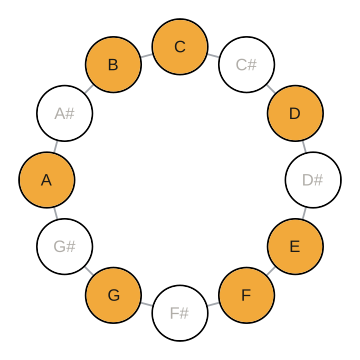
This scale holds many more chords than these, with extensions, inversions and every voicing on the neck. Find them all in Fretly
No 2 The C Shape

The open-position C major fingering. Anchored on the A string, frets 0 to 3. Active notes are the shape; the grey notes are the rest of the scale waiting in the neighbouring shapes.

Backing tracks
Jam this scale over these. They open on the track page.
This scale holds many more chords than these, with extensions, inversions and every voicing on the neck. Find them all in Fretly
No 3 The A Shape

Built from the open A chord form, frets 2 to 6. Where the C shape ends, this one begins: the overlap notes belong to both.

Backing tracks
Jam this scale over these. They open on the track page.
This scale holds many more chords than these, with extensions, inversions and every voicing on the neck. Find them all in Fretly
No 4 The G Shape

Built from the open G chord form, frets 4 to 8, anchored on the low E string.

Backing tracks
Jam this scale over these. They open on the track page.
This scale holds many more chords than these, with extensions, inversions and every voicing on the neck. Find them all in Fretly
No 5 The E Shape

Built from the open E chord form, frets 7 to 10. For many players the most familiar barre territory on the neck.

Backing tracks
Jam this scale over these. They open on the track page.
This scale holds many more chords than these, with extensions, inversions and every voicing on the neck. Find them all in Fretly
No 6 The D Shape

Built from the open D chord form, frets 9 to 13. After this the pattern repeats: fret 12 is fret 0 again, and the C shape returns.

Backing tracks
Jam this scale over these. They open on the track page.
This scale holds many more chords than these, with extensions, inversions and every voicing on the neck. Find them all in Fretly
No 7 The C Shape, an Octave Up

Here the system closes. Fret 12 is the octave, so it behaves exactly like fret 0: the C shape returns, note for note, one octave higher. Compare this board with shape 1 and you see the same pattern, moved 12 frets along.
That is the whole point of CAGED. Five shapes cover the neck, and then they repeat for as long as the frets last.

Backing tracks
Jam this scale over these. They open on the track page.
This scale holds many more chords than these, with extensions, inversions and every voicing on the neck. Find them all in Fretly